
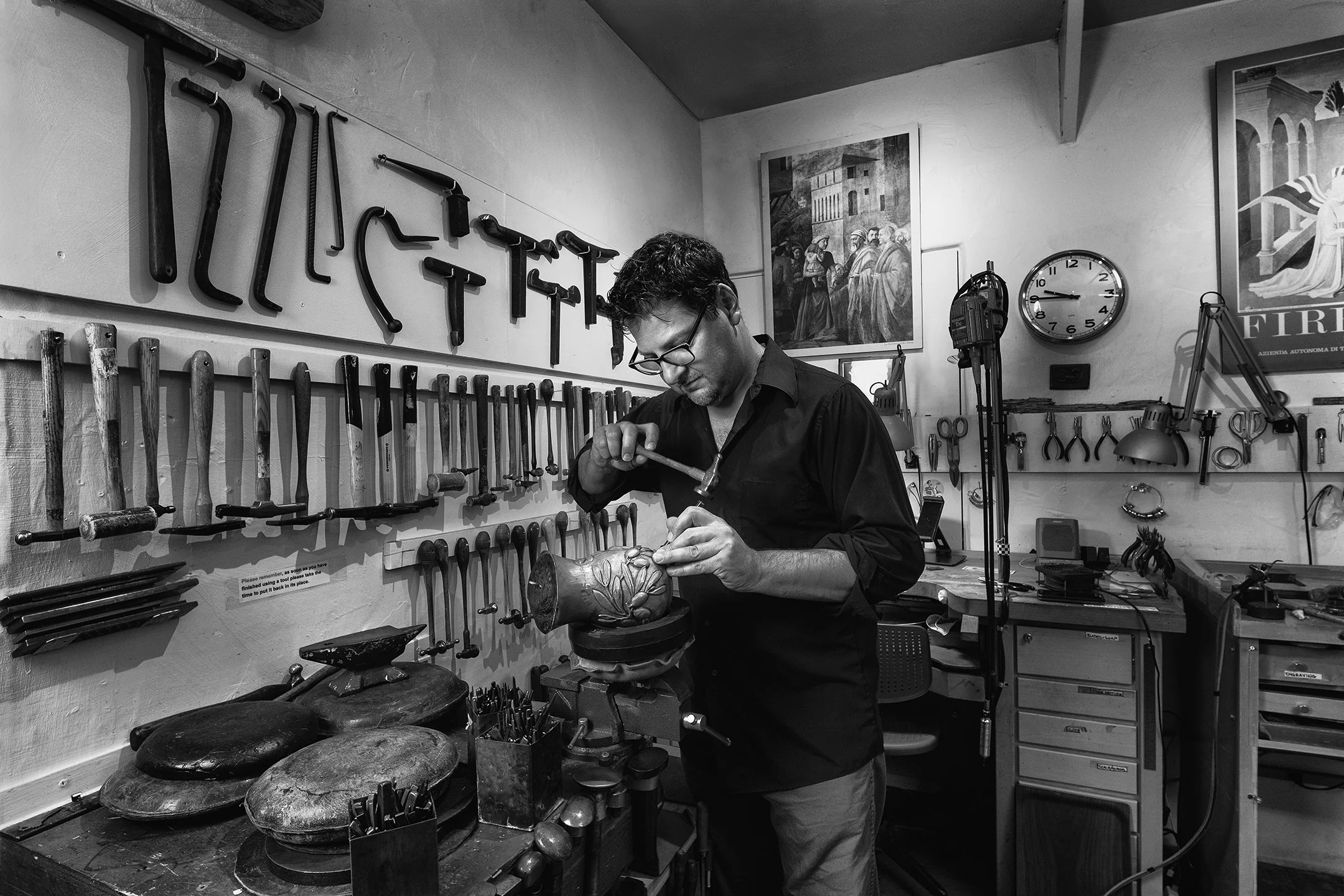
About Davide
Davide Bigazzi is a jeweler and metalsmith from Florence, Italy, whose work brings together traditional Italian craftsmanship and a contemporary sensibility. Growing up in Florence, surrounded by centuries of art and making, he developed an early appreciation for the city’s rich artistic traditions—an influence that continues to inform his work today.
Davide’s particular expertise is in the ancient techniques of chasing and repoussé, in which metal is shaped and embellished by hand to create sculptural, raised-relief designs. He studied these techniques under the Florentine sculptor and jeweler Bino Bini, working alongside him on projects for institutions including the Vatican, national banks, and churches.

He began his career as a bench jeweler at nineteen and went on to work as a designer, model maker, and production supervisor for Italian manufacturers. His freelance design work included projects for Italian fashion houses and fine silver manufacturers, giving him the opportunity to work at the highest levels of Italy’s jewelry industry.
In 1995, Davide received the International Artisans Award at the Mostra Internazionale dell’Artigianato in Florence. The recognition marked a turning point.
After years in the fast-paced design and manufacturing industry, he chose to return to what had drawn him to jewelry in the first place: the process of making by hand. He began focusing on one-of-a-kind pieces and the traditional techniques he had spent years developing.
In 1997, Davide and his wife, Elisa, opened their own studio near Florence. Their work soon found an audience in the United States, and in 2003 they moved their business to California. A few years later, they opened Davide Bigazzi Studio and Gallery in Menlo Park, creating a space where jewelry, metalsmithing, teaching, and the traditions of the Italian bottega could come together.
Today, Davide creates handcrafted jewelry and metalwork at his California studio and teaches jewelry and metalsmithing in the United States and Italy. Sharing these techniques has become an important part of his work—passing on skills and traditions while encouraging each student to develop their own approach to making.